Yesterday I watched Barbara@Projectkin chat to Taneya Koonce from Taneya Junk Journals about Genealogy Storytelling and Junk Journals. Taneya introduced me to Junk Journaling, a few months ago, when I came across a post she had written about this form of journaling. I am so grateful to her, as since that day, junk journaling has become a passion.
A Creative Way to Record, Preserve and Share Your Family History
For decades now, I have focused on researching, writing, and sharing my family history. The stories of my family were built mainly by following their paper trails, as there are have been very few stories passed down in my family. My main reason for recording my family stories is for preservation, as I am doubtful that there is anyone in my family, who will take over and build on my research materials.
Today, I would like to share with you, a different way of recording family history. It was totally new to me, but it’s been around for awhile so perhaps you have seen it. Junk journaling is a way of sharing your research and/or sharing your memories.
Despite the name, junk journaling has nothing to do with junk. Instead, it’s about turning everyday papers, photographs, documents, maps, and ephemera into meaningful, layered records of people, places, and lives.
As soon as I saw a video about junk journaling on Taneya’s Substack, I knew that this form of memory keeping was for me. It’s quite surprising really, as I’m not at all creative, and over the years, I have struggled to write in a daily journal. I was very happy when I read that the number one rule of junk journaling is that there are no rules. That gave me the confidence to have a go.
What Is Junk Journaling?
Junk journaling is a little like scrapbooking. It’s whatever you want to make it. Some junk journalers like to make beautiful, artistic scenes on their pages and others, like me, like to just lay down their epherema from the day, on the page.
Artistic skill isn’t necessary unless you would like to include it. There is no expectation of perfection. As soon as I heard that, I knew it was for me. I could do it in my own way, which I knew wouldn’t be artistic.
Why Junk Journaling Works So Well for Family History
Family history research is most often very layered. Family stories can often be built from bits and pieces of information found over time. Perhaps a newspaper clipping here, a certificate there, a photograph with no name on the back.
A junk journal allows you to:
combine documents, images, timelines, and notes in one place
tell stories without needing to write long formal narratives
experiment with layout, sequencing, and emphasis
create something that feels alive and personal
What Can Go Into a Family History Junk Journal?
Almost anything you already use or find in your family research can be put into your junk journal. The information is just presented differently.
You could use photocopies of the following records:
Birth, marriage, and death certificates
Newspaper snippets
Maps of towns and parishes
Immigration records
Photographs
Handwritten research notes
Timelines
Family trees folded into pockets
Recipe cards, letters, or oral history notes
Quotes or reflections about what the research reveals
A Different Way of Engaging With Our Research
One of the unexpected joys of junk journaling that I have found, is how it forces you to slow you down. For someone like me who is always on the go and ‘doing’, forcibly being slowed down has been great.
Many years ago, I was a quilter and felt exactly the same about patchworking and quilting. There was a forced slowing down, that I loved, as I cut the pieces of fabric and turned them into a beautiful, warm quilt. I am finding the same joy in junk journaling, as I layer pieces of paper and ephemera together. leaving space to include a small chunk of writing about my life or whatever is on my mind that day.
Memory Keeping
As with most family historians, I have an awareness of the importance of recording my own story, so on my list of things to do for many years has been memoir. I have started many times, but find it too difficult to write about my own experiences. This is where junk journaling stands alongside family history. Every day, along with my ephemera of the day, I am recording small chunks of the story of my life.
The Future
I will continue to use junk journaling to record my daily life and my memories, but I have a couple of other ideas. I am about to start a family junk journal, which will be the story of my family, and will include photocopies of my family photos. I’m really looking forward to getting this project started.
I also plan to create a vintage junk journal, using photocopies of photos of my ancestors. I think this will be a very powerful way of recording my family history.
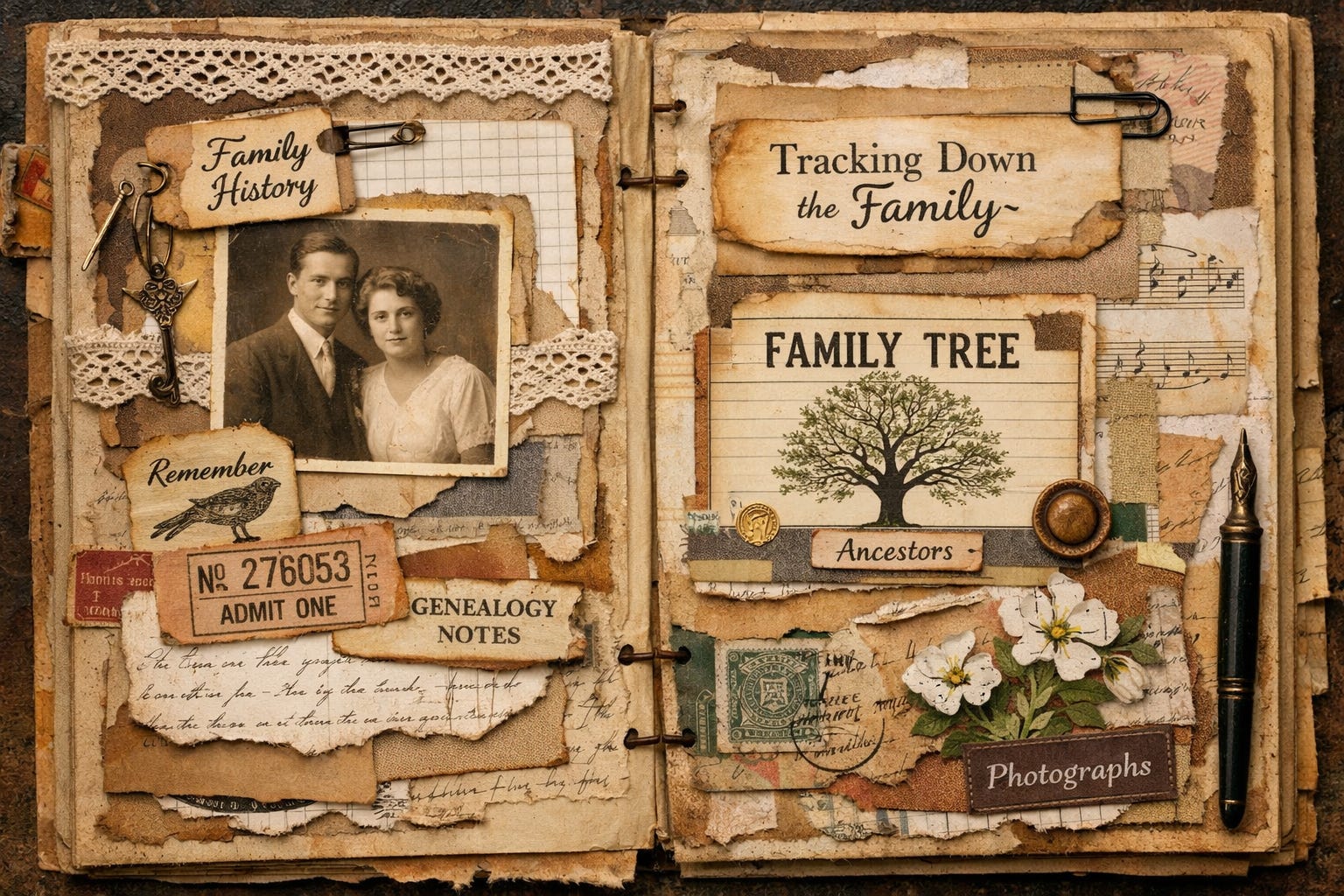
AI’s idea of a vintage junk journal
Below is the link to Taneya’s talk about junk journaling.

YouTube
Would you like to follow me on YouTube? I have recently created a YouTube channel, and would love you to follow me. There has been no content uploaded yet, but it won’t be long before the first recording appears. Drop me your YouTube handle as I would love to follow you back.
YouTube - Tracking Down The Family